Caring for a child with unique medical requirements is a full-time commitment.
You already know the mental and physical energy it takes to manage a daily routine. Often, the tasks that seem simple to others are the ones that leave you feeling the most drained.
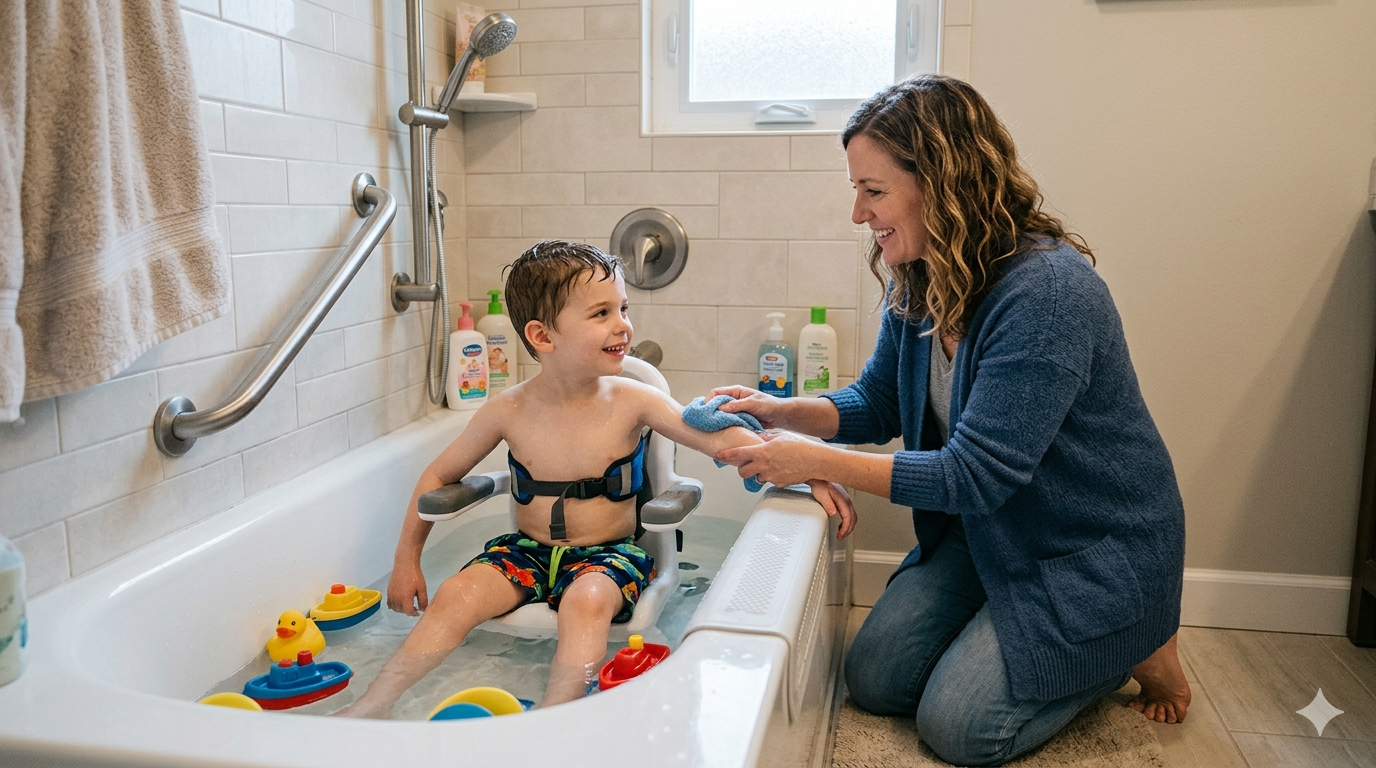
Bathing is a perfect example.
What takes other families a few minutes can take you more than an hour of careful planning. You might spend your nights worrying about safety or wondering how much longer you can physically manage the lifting.
Bathing assistance for children with special needs is a topic that deserves more than a basic checklist. It requires a conversation about privacy, physical health, and the reality of growing older.
The challenges of hygiene care don't stay the same. They shift as your child grows and their medical situation changes.
When your child is small, lifting them into a tub feels like a normal part of parenting.
As they grow, that weight becomes a significant risk to your own health. The mechanics of transferring a child with limited mobility into a standard bathtub can put immense pressure on your back and joints.
Many parents ignore this strain until an injury happens.
According to the U.S. Centers for Disease Control and Prevention (CDC), back injuries among caregivers are a serious concern that can impact your ability to provide long-term care.
A child with low muscle tone or seizure disorders faces specific dangers in a bathroom.
Even a few inches of water can be a risk if a seizure occurs. Slippery floors and hard surfaces make the environment unpredictable.
The mental energy you spend scanning for these dangers is exhausting. You aren't just washing your child; you are managing a high-risk environment every single day.
Dignity is a core part of how your child views themselves.
It means speaking directly to your child rather than talking about them while they are in the room. It involves explaining each step before you touch them or move them.
Giving your child choices, like which towel to use or the order of the routine, builds their sense of autonomy.
This is especially important for teenagers who are developing a stronger need for privacy. Research shows that children who feel respected during personal care tasks have higher self-esteem and better cooperation.
Small adjustments to your environment can make a big difference in daily safety.
Many families don't realize that high-quality adaptive equipment might be covered under programs like Medicaid.
Asking for help is a sign of strength, not a lack of capability.
You want the best for your child, and sometimes that means bringing in a professional who has the physical training and tools to keep everyone safe.
Professional in-home caregivers provide a level of safety that protects your body while ensuring your child receives thorough care.
For families in Georgia, the Georgia Pediatric Program (GAPP) offers Medicaid-funded in-home services for children with medically complex needs. This includes help with bathing, grooming, and dressing.
Our team at Services Offered From Above (SOFA) serves families across Fulton, Cobb, Gwinnett, and surrounding counties.
We focus on building a relationship with your child first.
Our caregivers are trained to handle medical equipment, such as feeding tubes and tracheostomies, while maintaining a warm, respectful environment.
If you are experiencing physical pain from lifting or if bath time has become a source of high stress for your child, it may be time to explore options. You don't have to wait for an injury to seek support.
Most children adapt well when the transition is handled with patience. Our caregivers at SOFA focus on building trust and following the routines you already have in place to make the transition feel natural.
Yes. Licensed professionals are trained to provide care around medical equipment. We work closely with your healthcare providers to ensure all safety protocols are followed.
In Georgia, if your child qualifies for GAPP, these services are often provided at no out-of-pocket cost through Medicaid. We can help you understand the eligibility process.
Caregivers use the equipment available in your home, but we can provide guidance on which adaptive tools might be best for your child's specific mobility needs.
The frequency depends on your child’s specific medical necessity and the hours approved through your insurance or GAPP. We work with you to create a schedule that fits your life.
Bathing your child is an act of care, but it is also a physical job.
You aren't failing by admitting that the job is getting harder. Seeking support allows you to focus on being a parent rather than just a physical therapist or a lifter.
Services Offered From Above is here to provide the compassionate, professional help your family deserves. Our goal is to make sure your child is safe and respected while giving you the breathing room you need.
If you want to see how we can support your daily routine, reach out to our team today. We are ready to help you find a sustainable way forward.
Disclaimer: The information we share here is meant to support and guide families. Please remember, it is for informational purposes only and is not a substitute for professional medical advice from your child's doctor. Always consult a qualified healthcare provider with any questions about a medical condition, as they know your child's specific needs best. If you are experiencing a medical emergency, call 911 immediately.