
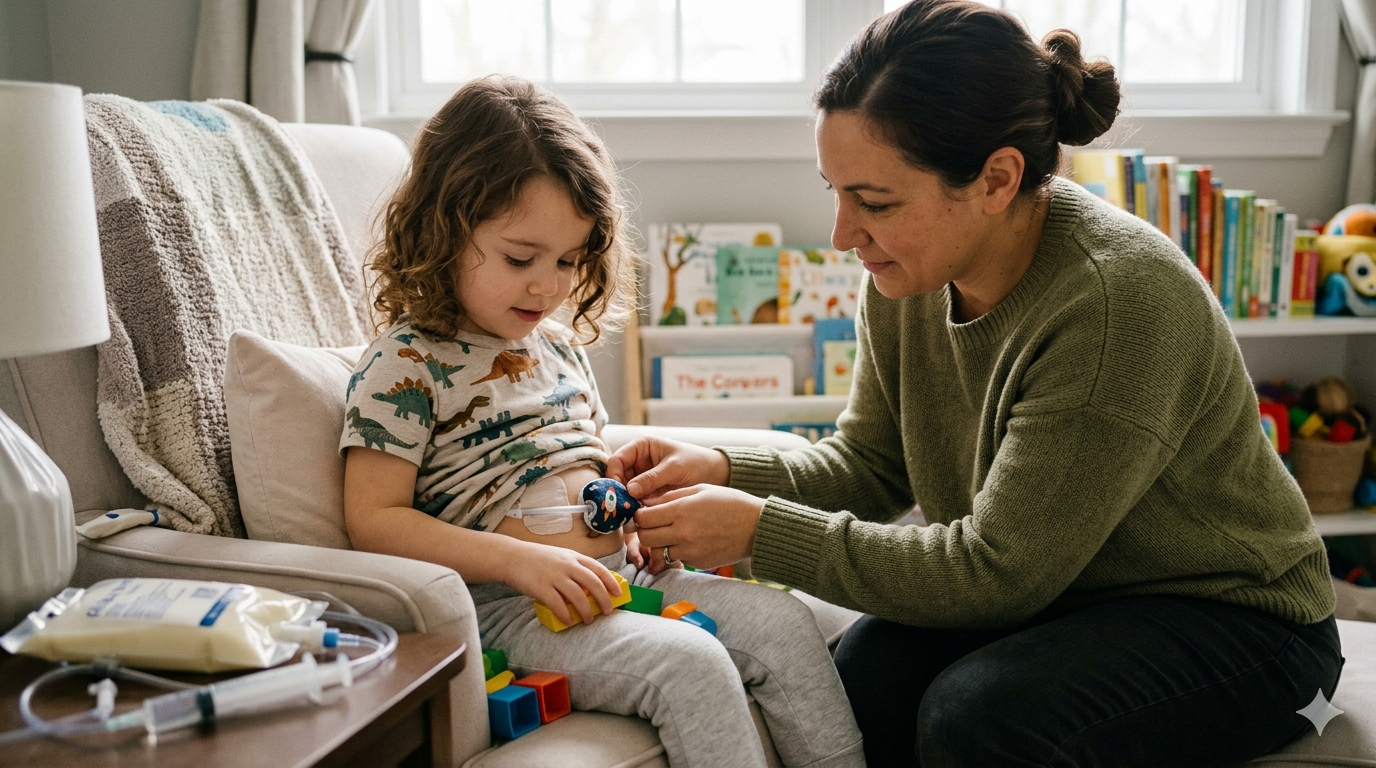
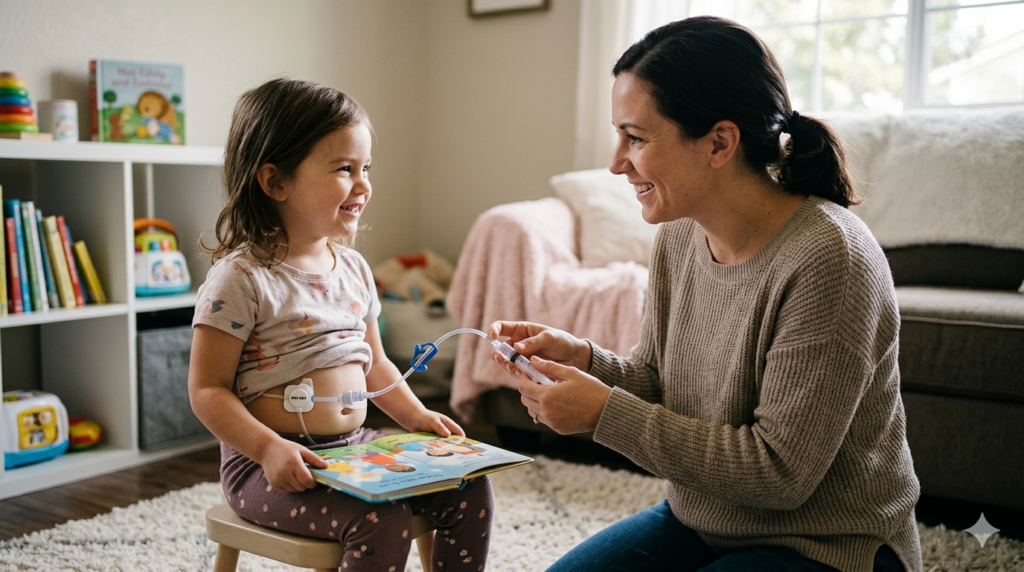
Caring for a child with special needs is hard work.
When your medically fragile child relies on a gastrostomy tube for nutrition, the weight of that responsibility feels heavy.
You have probably heard that G-tube care at home for children gets easier with time. Your hands learn the motions. You memorize the schedule.
However, routine does not always mean easy.
The stress rarely disappears completely. Managing this medical device can change how your household operates. It affects your sleep, your daily plans, and the time you have for your family.
This guide offers an honest look at what tube feeding demands from parents. We also share how the right support brings comfort, joy, and stability into your home.
A G-tube is a flexible tube inserted through the abdominal wall directly into the stomach. It allows food, fluids, and medications to bypass the mouth.
Children receive these tubes for many reasons.
Some cannot swallow safely. Others face chronic illnesses that make eating exhausting. Ultimately, these children cannot receive adequate nutrition solely by mouth.
Thousands of families manage G-tubes daily. However, prevalence does not equal simplicity. You do not have to handle everything alone. Our goal is to make families feel they are no longer alone and have found a trustworthy partner.
Hospital discharge often happens quickly. You receive instructions, watch a demonstration, and head home.
The learning curve is steep. The stakes feel incredibly high.
Feeding is a major part of the day. You might use bolus feeds (larger amounts given quickly) or continuous feeds (smaller amounts pumped over hours).
You must also handle several other tasks:
These tasks create a relentless daily rhythm.
Beyond physical tasks, there is a massive cognitive load. You coordinate between specialists. You monitor subtle changes in your child's skin color or tolerance to formula.
This constant vigilance causes exhaustion. Many parents feel isolated because friends and extended family rarely understand the strict care requirements. We want families to know we see them and understand their situation.
Problems can arise even with excellent training. Understanding these issues helps you respond calmly.
Formula residue or medications can clog the tube. A blocked tube stops feedings, and forcing fluids through the tube can damage the device. Prevent clogs by flushing the tube with warm water regularly.
The stoma needs constant attention. Keeping the site clean and dry is vital. Look out for signs of redness or drainage, as that might indicate an infection. Granulation tissue and raised, pink skin around the tube are common and may require treatment.
Tubes sometimes come out. A child might pull the tube, or the balloon might deflate. If this happens, the stoma can close within hours. Quickly reinserting a replacement tube is crucial.
The hospital trained you to perform medical tasks. They did not train you to do this while parenting other children, working, and maintaining your own health.
Professional help is a necessity, not a luxury. SOFA is a support system built on trust and compassion.
A licensed professional brings trained eyes and hands into your home. They can:
At Services Offered From Above (SOFA), we act as an extension of your family's care. We bring skilled nurses and compassionate caregivers into your home.
We can assist with G-tube feeding, tube maintenance, and the daily routines to keep your child safe.
For qualified families, this care comes at no out-of-pocket costs. The Georgia Pediatric Program (GAPP) is a Medicaid-funded service that fully covers in-home care.
Yes, your child can typically bathe and swim once the stoma site fully heals. Your doctor will clear your child for water activities. Always ensure the tube is clamped tightly and the feeding port is closed before getting into the water.
Loose-fitting clothing works best to prevent pulling or friction against the stoma. Many parents prefer one-piece outfits with snaps or specially designed adaptive clothing that provides easy access to the feeding port.
Children receiving continuous feeds at night are often advised to sleep with their head elevated at a 30-degree angle. This position helps prevent reflux and lowers the risk of aspiration.
Your child's gastroenterologist or dietitian prescribes a specific formula based on their nutritional needs, allergies, and tolerance. Never switch formulas without consulting your medical team first.
Traveling requires careful planning. Always pack extra feeding supplies, replacement tubes, an emergency kit, and a copy of your child's medical records. If flying, carry medical supplies in your carry-on luggage.
A low-profile G-tube, often called a button, sits flush against the skin. It is less visible under clothing and harder for children to pull. Many families transition to a button once the initial stoma heals.
Managing G-tube care at home for children takes immense strength. We validate their hard work and their need for a helping hand.
You do not have to carry this heavy load by yourself. Bringing a skilled nurse into your home gives you time to focus on simply being a parent.
Learn more about our faith-inspired mission by visiting our About Us page. If you are ready for support, fill out our SOFA request form to see how we can help your family today.
Disclaimer: The information we share here is meant to support and guide families. Please remember, it is for informational purposes only and is not a substitute for professional medical advice from your child's doctor. Always consult a qualified healthcare provider with any questions about a medical condition, as they know your child's specific needs best. If you are experiencing a medical emergency, call 911 immediately.